Showing posts with label Flare. Show all posts

Built Up Back Pressure Calculation


My friend, do you still remember? One of consideration in selection of relief valve type is built up back pressure. In this article I will explain you how to calculate the built up back pressure. Oh, do you still remember what is built up back pressure? Is it a constant or variable?

Built up back pressure is pressure at outlet PSV in open mode, a variable back pressure since it is depend on the relieving flow. Read my previous post about back pressure for more detail in built up and superimposed back pressure
In this explanation I use a general flare system which the disposal is discharged to atmosphere via flare stack. Let imagine, when relief valve open, relieving fluid flow thru Tail Pipe –Sub Header – Main Header-Flare Drum-Seal Water Drum – Flare Stack – Flare Tip and finally discharged to atmosphere at certain height ( for safe disposal purpose)
The Built up back pressure can be calculated by count up total pressure drop at the pipe, drum, stack and tip. Start calculation from the pressure drop at the tip, then at stack until tail pipe of the relief valve. The built up back pressure is pressure that exist at outlet relief valve ( that is same as with total pressure drop from the tail pipe to the flare tip)
For more clear, see this picture below


To calculate the back pressure of the PSV, determine the pressure drop at tip, stack, Water Seal, KOD and pressure drop along the pipe from point 2 to point 7. Since the pressure at outlet tip is atmospheric pressure condition, we can calculate the pressure at outlet PSV, which is a total pressure drop along the system from point 1 to point 7.
The basis back pressure calculation is rated flow. Rated flow is flow rate based on actual orifice area of PSV. My friend, once the back pressure is calculated, then we can determine the PSV type. For built up back pressure less than 10% of PSV’s set pressure, a conventional type can be used. Balance below type can be used for back pressure up to 30%, and pilot type shall be used for higher back pressure. Note shall be made, even though the selection of PSV type is based on the back pressure consideration, it is not the only consideration in PSV selection
After the back pressure calculated, we can also check the fluid condition due to decreasing pressure from inlet PSV (relieving pressure) to outlet PSV (back pressure) using HYSYS simulator. Is hydrate formed there? is the icing occurred? And for liquid phase, is the liquid will be flashed?
The back pressure calculation is so simple, isn’t? How about if there is any PSV open simultaneously? The difference is only the combined flowrate from others PSV shall be considered in pressure drop calculation. Hopefully this picture help you more understand with the concept of back pressure calculation.


<< correction : W3 at above picture shall be 1200 lb/hr instead of 1500lb/hr>>

See the picture above. I will explain you why the calculation of built up back pressure is very important not only for PSV design but also for flare system design. Let imagine;
- PSV 01 is set at 50 psig with relieving flow of 200 lb/hr.
- PSV 02 is set at 100 psig with relieving flow of 1000 lb/hr.
In case the two PSV open simultaneously, what do you think what happen with the PSV 01 if the back pressure of PSV 02 is more than 50 psig? Of course the PSV 01 cannot open properly
What is the solution? Hmm,, look at this picture, it will show you a better configuration of flare header system to avoid that condition


<< correction : W3 at above picture shall be 1200 lb/hr instead of 1500lb/hr>>

The other options are increase the flare header size or provide 2 flare header for high pressure and and low pressure separately.
The above sample is a very simple case. Sometimes, for instance in power failure case, there is many PSV will open at the same time. The back pressure for each PSV shall be checked to ensure each PSV can properly operated. The back pressure profile of each PSV can be used to determine the configuration of the flare system
My friend, that’s all, I can share to you. Hopefully, this topic reminds us that the back pressure is something very important to be considered both in PSV and flare system design

Thank you for your attention.


Share:

Back Pressure Effect

In the previous article, two kinds of back pressure have been discussed. We have already understood that back pressure has several impacts to PSV performance. In this article, we will learn the impact of back pressure on the relief valve opening, operation and flow capacity.

My friend, If you don’t have a good understanding on the definition of terminology such as; overpressure, accumulation, set pressure, re seat pressure etc, I guest you will be confused with my explanation. In this article, I won’t to explain each of them, so please refer to API 520 part I by your self. It’s very important to understand the meaning of its definition.

PRESSURE RELIEF VALVE OPENING

Superimposed back pressure has impact to opening of conventional relief valve type. This back pressure will give additional spring force onto valve disk in closed position. Therefore, the actual spring setting can be reduced by an amount equal to the amount of superimposed back pressure.

Hopefully, this picture will help us.


For balance and pilot type, the compensation of the constant superimposed back pressure is not required

PRESSURE RELIEF VALVE OPERATION

Excessive of built up back pressure has impact the conventional valve operates in unstable condition. Its may be chatter or flutter. Chatter is rapid motion of closing and opening valve where the disc contacts with the relief valve seat during cycling, whereas flutter is not contact with the seat. Chatter cause damage to the valve.

PRESSURE RELIEF VALVE CAPACITY

Built up back pressure has impact reducing the valve capacity. High back pressure reduces the lifting of disc result in reduction of flow capacity. For conventional type, built up back pressure shall not exceed 10% of set pressure at 10% allowable overpressure. For application that allowable overpressure is higher than 10%, say 16% of multiple valve application, then the built up back pressure up to 16% of set pressure is allowed for conventional type.

See the picture below of capacity correction factor due to back pressure for conventional type where the spring setting compensation for superimposed back pressure is required.


The figure below shows that the capacity of balance below type will be reduced significantly due to back pressure. Look at this picture, hopefully you get the answer why we choose to use balance below type for back pressure up to 30% at 10% allowable overpressure.


Finally, I can share this topic for you. Hopefully we get better understanding on the importance of the back pressure. The back pressure is one of consideration for optimization flare system. For new design system, which one do you prefer, use larger size of tail pipe to reduce back pressure or use balance below type to overcome it?

Friends, Thank you for reading. Please correct me if I am wrong.

Share:

Built Up and Superimpossed Back Pressure

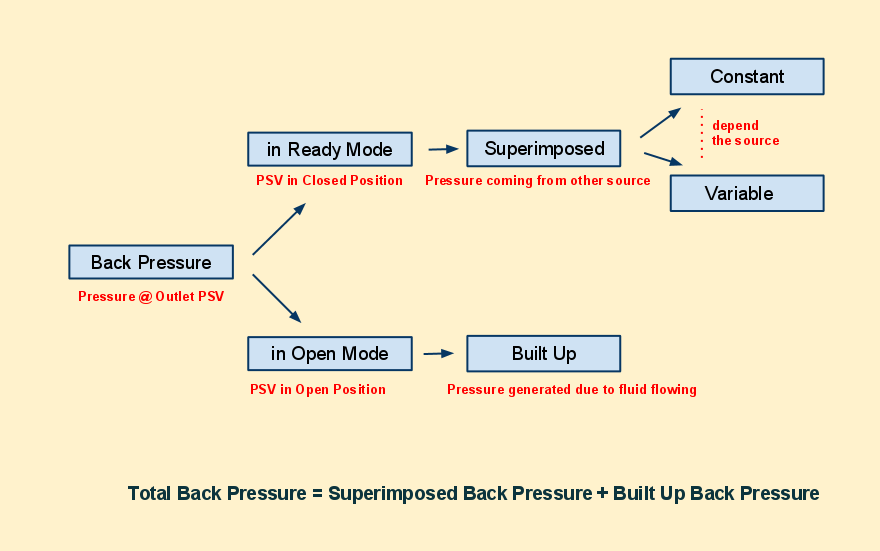
Back pressure is defined as pressure that exists at PSV’s outlet. It has impact to performance of PSV, hence its value should be informed to vendor therefore shall be stated in the datasheet. Good concept understanding of the back pressure is helpful when calculates its value.

In this article, the following term is used for easier understanding
1. PSV in Ready Mode - PSV still in closed position - system pressure less than PSV’s set pressure - so that the PSV is not open yet
2. PSV in Open Mode - PSV in open position - system pressure higher than PSV’s set pressure - so that PSV is open

Superimposed back pressure is pressure coming from other sources when PSV in ready mode. It may be constant or variable depends on the sources.
Built up back pressure is pressure generated as a result of fluid flowing through PSV in open mode.
I hope this picture will give you better explanation


The picture above seems very theoretical. I do very understood that you prefer something more practical.
See this picture. It will help you get better understanding of the constant back pressure.


When blocked outlet case at downstream occurred, the PSV will open and built up back pressure is generated. See this picture.


The other important point is the spring PSV shall be capable for handling pressure not more than 7.5 psig, so that PSV will start to open at 10 psig. For this case, let your vendor know with the system and back pressure value.

Here is the other system has variable superimposed back pressure.


Back pressure can be calculated by means of hydraulic calculation, Flarenet or HYSYS simulator. I suggest you to use FlareNet for project and critical system where accurate calculation is required. FlareNet will give a better result.

Based on the back pressure, the PSV type can be selected. For built up back pressure less than 10% of PSV’s set pressure, a conventional type can be used. Balance below type can be used for back pressure up to 30%, and pilot type shall be used for higher back pressure.

Please note, even though back pressure is very important, it is not the only consideration in selection of PSV type. For instance, when reseat pressure of conventional PSV is lower than the operating pressure, it can’t be used even though the back pressure is lower than 10% of PSV’s set pressure. Pilot type is required for this case.

Refer to API 520 part I for more detail about back pressure. Hopefully, this article, at least help you get better understanding of the back pressure and realize the importance of it. I think, we still need more discussion how back pressure has impact to PSV performance, how to simulate it etc. Other time, I will make it as dedicated posting for you.

My friends, I feel that’s all I can share to you for this week. Hopefully, someday we will be a good process engineer. Even though we don’t have many experience recently, we still have the most important; it’s a spirit to grow better. We should take care of it with our life.

Thanks you.
See you next week.

Share: